
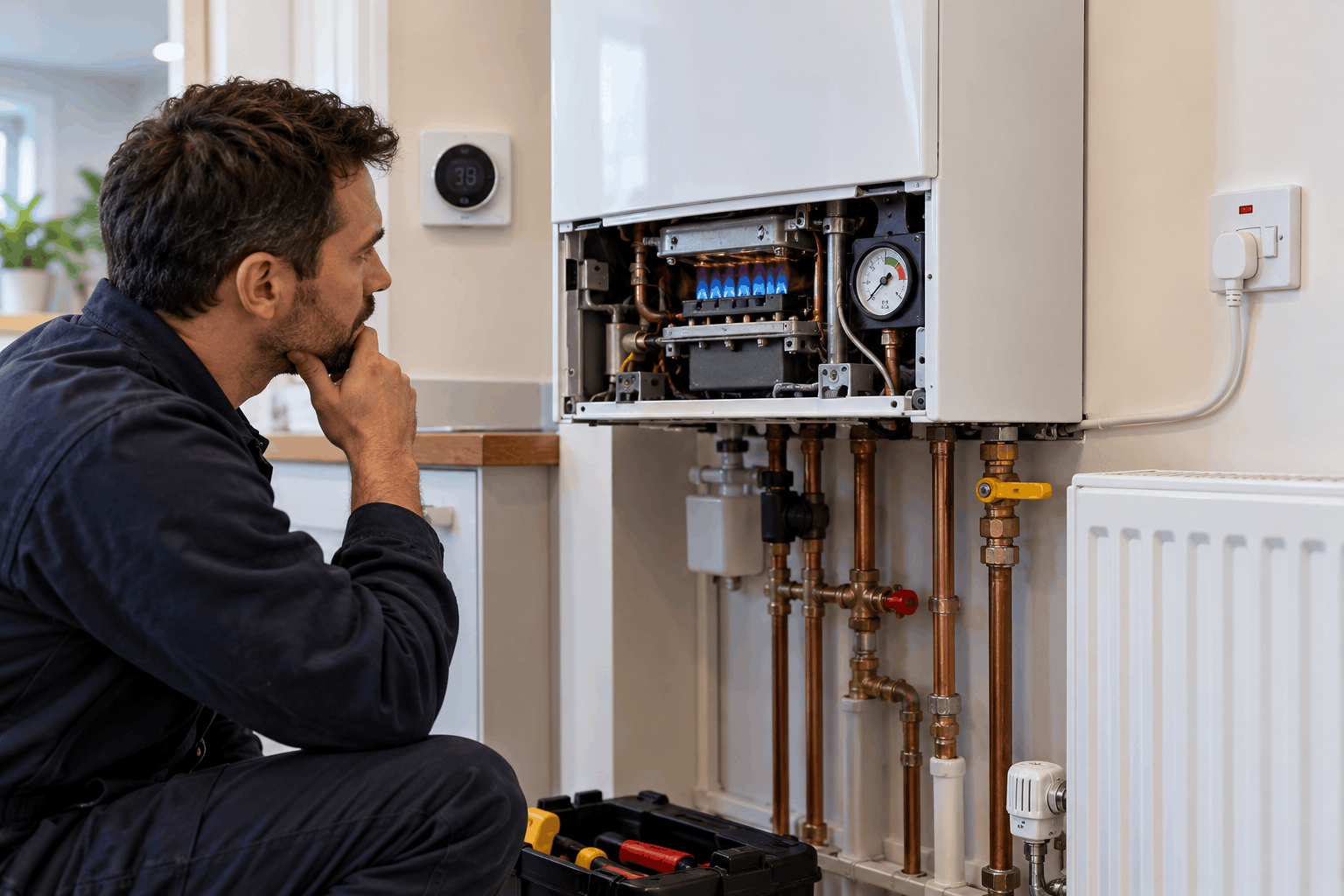
Most boiler problems can be solved at home with a few alterations and minor DIY repairs, including thermostat adjustment, checking boiler pressure, and ensuring the proper connection to the power supply.
Understanding and checking these things can help restore the boiler’s functionality in minutes, but never try to open the case and do mechanical work on your own. In this blog, we will discover the key things to check when your boiler is not working and what warning signs indicate you should call a boiler specialist.
Check external components such as the thermostat, power supply, pressure level and gas or oil supply when the boiler stops working. Usually, these checks solve the problem and save the cost of calling a boiler engineer.
A thermostat controls the temperature and directs the boiler to generate heat. One possibility that your boiler is not working can be the thermostat setting. Adjust the temperature of the thermostat higher than the current room temperature and see whether it responds.
Low boiler pressure is one of the main reasons behind a boiler not working properly. Check the boiler pressure gauge or digital pressure reading to ensure that it is according to the manufacturer’s instructions. If the pressure is too low, it can be repressurised at home for some boilers.
Sometimes there is no mechanical fault behind a non-functional boiler. A tripping circuit breaker or power cut-off can be the problem. Check whether the power supply is switched on and the boiler is getting enough power to work properly.
A boiler burns gas or oil to heat the water. If there is less or no gas supply, then the boiler may stop working and can cause damage. Check that the gas supply is switched on and make sure nothing is interrupting its supply to the boiler. According to HSE statistics, around 7 people die every year due to carbon monoxide poisoning caused by gas appliances.
Boilers nowadays display fault codes in case of any problem with them. Check those codes against the manual to understand the issue. These codes indicate ignition failure or power supply issues, which helps professionals come prepared.
If you have checked all the possible issues and still are not finding any issue, then a simple reset can solve the problem, but not for all boilers. Check the manual instructions and reset accordingly if it is allowed.
Frequent breakdowns, unusual noises and rising energy bills can all be warning signs that the boiler is failing and needs repair. Understanding these signs can help you identify the problems before any damage occurs.
Regular maintenance and simple checks can keep your boiler functional. Taking some preventive measures can help keep the boiler up to date and increase its efficiency. Some useful tips to prevent boiler failure include:
You can check pressure through a round dial or digital display panel attached to the boiler.
Yes, a boiler can explode if the pressure is too high and safety mechanisms fail to release it.
You can tell the boiler is on by checking its display, sound and the status of the room thermostat.
Yes, a boiler should be serviced after 12 months to maintain its functionality. For boilers that are more than 10 years old, it is recommended to service twice every year.
A boiler can fail to work or produce no heat if the pressure is too low, the supply connection is damaged, the gas supply is restricted, or the temperature is set too high on the thermostat. Most boiler problems can be solved at home with simple checks and adjustments.
Regular maintenance and some preventive measures can keep your boiler efficiently functional throughout every season. If you are not able to identify any issue after these checks, then you may reset the boiler according to the manufacturer’s instructions, or you can contact MSJ Plumbing and Drainage LTD for professional assistance.